Installing Signage in California: An Aesthetic, Seismic, and Legal Guide for Los Angeles & San Francisco
Designing or installing a sign for a business in California is an experience unlike anywhere else in the world. Particularly in Los Angeles and San Francisco, this process is not merely a graphic design task; it is a rigorous legal and engineering challenge.
Table of Contents
ToggleI often hear this question from my clients: “Why can’t we just hang a nice sign and be done with it?”
The answer is simple: Because California law doesn’t just see your sign as a marketing tool; it views it as an energy load, a seismic threat, and an urban aesthetic element.
In this guide, I have stripped away the academic jargon to provide you with the essence of signage codes in LA and SF, updated for 2025 standards.
The Core Philosophy: What Drives the Rules?
While California’s regulations may seem complex, they are built upon three main pillars. When developing a project, you must ask these three questions:
- Aesthetic Preservation: Does my sign disrupt the historic fabric or character of the neighborhood? (Crucial in San Francisco).
- Energy Efficiency (Title 24): Does my lighting comply with state energy standards?
- Public Safety (Seismic): If an earthquake hits, could this sign fall on someone?
State Rules: Energy and Earthquakes (Title 24 & CBC)
No matter which city you are in, two massive state-level regulations bind everyone in California.
Title 24: Lighting Compliance
The era of old-school, all-night burning incandescents or uncontrolled neon is over. The California Energy Code (Title 24, Part 6) mandates the following:
- Automation is Mandatory: Your sign must have a photocontrol (daylight sensor) and an automatic time switch. You don’t have the luxury of saying, “I forgot to turn it off”; the system must shut down automatically at sunrise.
- Dimming Capabilities: If your sign stays on all night, it must automatically dim its power by at least 65% during specific hours.
- LED Necessity: Due to strict watt-per-square-foot limitations (Lighting Power Density), we are now effectively limited to high-efficiency LED technology.
Seismic Safety: What is Positive Attachment?
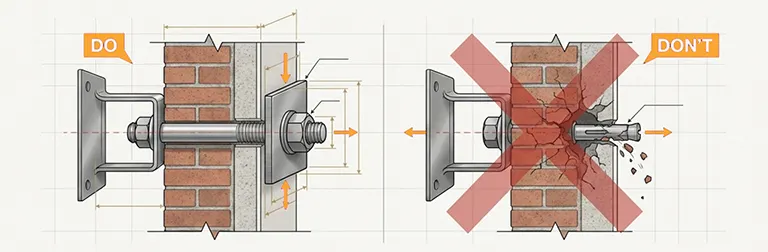
California is a Seismic Zone 4 region. Because of this, signs cannot simply be “glued” to a building; they must be mechanically anchored.
- Positive Attachment: You cannot rely on gravity or friction. Regardless of weight, the sign must be mechanically secured to the wall with studs or backing.
- Engineering Calculations: For signs weighing over 400 pounds (approx. 181 kg), engineering approval is mandatory. In the event of an earthquake, that sign must not budge.
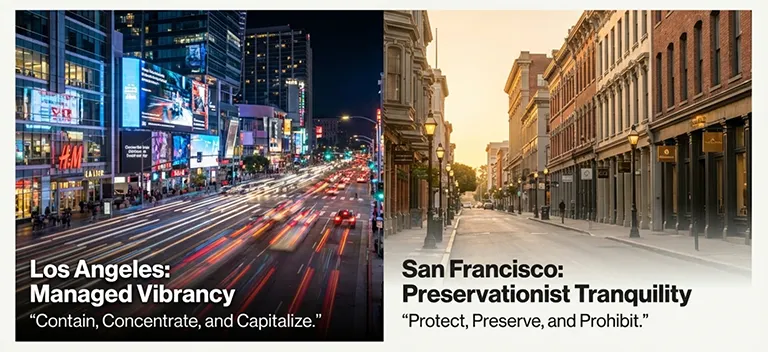
Los Angeles: "Sign Districts" and Visual Blight
Los Angeles is a paradox. Don’t be misled by the massive digital screens you see in Hollywood movies; those exist only in specially permitted zones.
What are Sign Districts?
To prevent “visual blight,” the city restricts advertising to specific areas known as Supplemental Use Districts (e.g., Hollywood, LA Live, Downtown).
- Tier 1 Zones: Digital screens and large-scale advertisements are permitted here.
- Everywhere Else: Digital billboards, pole signs, and cabinet signs (can signs) are generally prohibited.
The Golden Rule for LA: If you are not in a designated “Sign District,” you must opt for simple, building-integrated, or monument-style signage.
San Francisco: History and Character
In San Francisco, the enemy isn’t “visual blight”—it’s “lack of character.” The city is obsessive about preserving the soul of its neighborhoods.
The Plastic Sign Ban
In historic districts (Jackson Square, Alamo Square, etc.), plastic, Plexiglas, or acrylic “cabinet signs” are strictly forbidden. The city administration views these materials as “cheap” and “disrespectful to history.”
- What Should You Use? Painted wood, metal, enamel, or exposed neon.
- The Risk of Discretionary Review: Even if your sign is technically legal, residents can file for a “Discretionary Review” (DR) if they feel it doesn’t fit the “neighborhood vibe,” effectively halting your project. In SF, getting along with the neighbors is just as important as getting along with the planning department.
Comparison: LA vs. SF
To help you quickly understand what you’re up against, I’ve prepared this comparison table:
| Feature | Los Angeles (LA) | San Francisco (SF) |
|---|---|---|
| Primary Focus | Preventing Visual Blight | Preserving Historic Character |
| Digital Signage | Only in special zones (Hollywood, etc.) | Almost entirely banned |
| Banned Materials | Cabinet & Pole Signs | Plastic & Acrylic |
| Risk Factor | High daily fines | Neighbor complaints (Discretionary Review) |
The Fines: Why You Shouldn't Take the Risk
The era of “pay the fine and move on” is over.
- Los Angeles: Following the New York model, fines for illegal signage increase exponentially based on size. You could face penalties of up to $48,000 per day.
- San Francisco: If you remove a historic sign without permission or damage a building’s facade, you could face a one-time fine in the hundreds of thousands of dollars.
Comparative Regulatory Analysis: Los Angeles vs. San Francisco
The table below summarizes the distinct approaches to “strictness” in both cities.
| Feature | Los Angeles (LA) | San Francisco (SF) |
|---|---|---|
| Core Regulatory Mechanism | Sign Districts (SN): Creates high-density sign “islands” within a sea of prohibitions. | Planning Code & Historic Review: Detailed aesthetic review based on neighborhood character. |
| Digital Signs | Permitted (Restricted): Allowed only in Tier 1 Sign Districts (Hollywood, DTLA). Prohibited in most other areas. | Highly Restricted: Generally prohibited in historic/neighborhood zones. Permitted with strict limits in select hubs (e.g., Union Square). |
| Material Restrictions | Blight-Focused: Bans “Can/Cabinet” and “Pole” signs to modernize street skylines. | Authenticity-Focused: Bans plastic/acrylic in historic districts; mandates wood, metal, or high-quality finishes. |
| Seismic Retrofit | Aggressive: Heavy pressure for brittle concrete/soft-story retrofits. Signs on these buildings are scrutinized. | Preservationist: Retrofits must not damage historic facades. Tension exists between safety upgrades and visual preservation. |
| Permit Process Speed | Zoning-Driven: Can be slow, but rules are predictable if located within a Sign District. | Discretionary/Political: “Discretionary Review” allows neighbors to object, potentially extending the process by months. |
| Enforcement | LADBS & Penalties: Focuses on illegal billboards and unpermitted supergraphics. | Planning Enforcement: Focuses on aesthetic complaints from neighbors (e.g., “this sign is too ugly/bright”). |
Conclusion: Recommendations from Burak
A successful signage project in California cannot be managed with a “design first, get permit later” approach. We must reverse-engineer the process:
- Analyze the Zone: Is the building in a historic district? Is it inside a Sign District?
- Check the Wall: Is the building Unreinforced Masonry (URM)? Will it hold the anchors?
- Calculate the Energy: Select Title 24-compliant LEDs and sensors from the very beginning.
Remember, in 2025, a good sign isn’t just a glowing box; it is an architectural element that is engineered, environmentally responsible, and respectful of the law.
Do you need technical support for your project? Feel free to contact me for details.
Ready to Sign Your Project? Do It Right the First Time.
At SignsAtelier, we want your sign to stand the test of time—both structurally (surviving Seismic Zone 4) and legally (surviving city inspectors).
Whether you need a minimalist, historic-compliant masterpiece for San Francisco or a complex, Title 24-ready illuminated system for Los Angeles, we handle the entire lifecycle:
- Precision Production: High-quality materials that meet strict fire and aesthetic codes.
- Permit & Engineering Drawings: We navigate the labyrinth of city planning for you.
- Certified Installation: Seismic anchoring and electrical compliance guaranteed.
Don’t risk a $48,000 daily fine or a red tag for a budget shortcut.
FAQ About California Signage Regulations
Here are answers to the most common questions I receive from clients regarding signage projects in Los Angeles and San Francisco.
Can I just install a standard plastic cabinet sign (box sign) to save money?
In most cases, no. Los Angeles generally prohibits new “canister” signs to reduce visual blight. In San Francisco, especially in historic districts, plastic is strictly banned due to material quality standards. You are better off investing in painted wood, metal, or exposed neon, which are more likely to be approved.
What exactly does "Title 24" mean for my sign?
Title 24 is California’s energy efficiency code. For signage, it means you cannot just hook up a light switch. Your sign must have automatic controls (like a photocell to turn off at sunrise) and, if it runs all night, it needs dimming capabilities to reduce power by at least 65% during specific hours. It essentially mandates the use of high-efficiency LEDs.
Do I really need a structural engineer for a simple wall sign?
If your sign weighs over 400 pounds (approx. 181 kg), yes, it is mandatory. Even for lighter signs, because California is in Seismic Zone 4, you must prove “positive attachment.” You cannot rely on friction or simple screws; the sign must be anchored to withstand earthquake forces without falling onto pedestrians.
Is it true that Los Angeles allows digital billboards now?
Only in very specific areas. Digital billboards are permitted primarily in “Tier 1 Sign Districts” like Hollywood or Downtown LA. Outside of these designated zones, new off-site digital advertising is generally prohibited to protect traffic safety and neighborhood aesthetics.
What happens if I install a sign without a permit?
The risks are severe. Los Angeles charges daily fines that can reach up to $48,000 for large illegal signs. San Francisco can impose massive penalties for altering historic structures without permission. Furthermore, unpermitted signs are a liability; insurance may not cover damages if an illegal sign falls during an earthquake.
Get a Free Compliance Check & Quote Fill out the form below. Tell us your address and what you envision, and I’ll personally take a look at your zoning regulations.
Regional Permit & Zoning Guides
Navigating local ordinances can be complex. Explore our state-specific guides to ensure your signage meets all legal requirements across key markets.